


Displaying pictures of decaying nuclear waste barrels and a girl with a brain tumor, Tao Aborigines from Lanyu (蘭嶼, also known as Orchid Island) yesterday accused the government and Taiwan Power Co (Taipower) of trying to annihilate the tribe by storing nuclear waste on the island for three decades.
“I cry everytime I tell the story of this five-year-old girl because I’m also a mother, and I believe every mother would feel heartbroken when she sees this picture and hears the story,” Sinan Mavivo, an anti-nuclear activist and resident of Lanyu, told a news conference in Taipei, while showing a picture of a five-year-old girl whose head was wrapped in gauze.
“When I first saw her, I thought she was wearing a mask, but no, it was gauze. She has to wear it because she has to undergo several treatments for brain tumor, and since she’s so little, the procedure has to be done through her mouth,” Sinan Mavivo said.
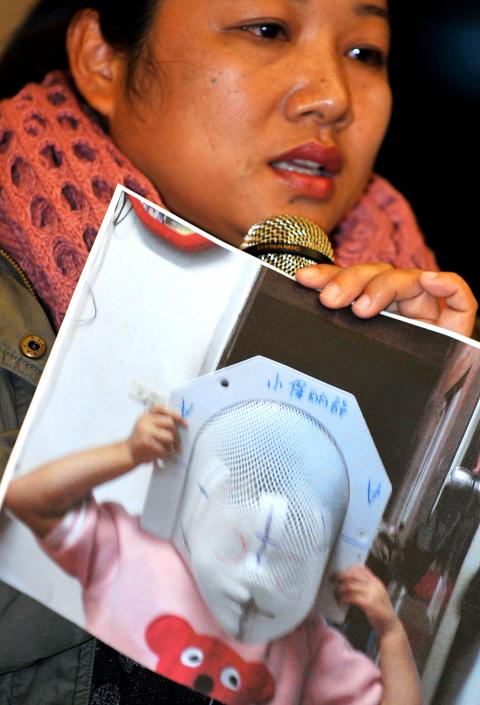
Photo: Mandy Cheng, AFP
She choked back sobs as she talked, while Democratic Progressive Party Legislator Tien Chiu-chin (田秋堇) and Taiwan Solidarity Union Legislator Lin Shih-chia (林世嘉) wiped away tears from their faces when they saw the picture.
Sinan Mavivo said that although there is no research establishing a firm connection between cancer and nuclear waste, official figures show that the cancer rate on the island has risen since the nuclear waste facility was opened in 1982.
She showed another picture in which workers were shown working in a trench where nuclear waste barrels are stored in the Lanyu Nuclear Waste Storage site. Most of the barrels have deteriorated, and dust-like nuclear waste was scattered around the trench.
“This is what it looks like in the trench, and the radioactive dust scatters whenever they open the cover over the trench to inspect the barrels, contaminating the land and sea,” Sinan Mavivo said.
After seeing the pictures, Tien said she recently visited the nuclear waste storage facility at the Guosheng Nuclear Power Plant in New Taipei City’s (新北市) Wanli District (萬里), which she said was “fully air-conditioned with temperature and humidity control.”
“Why is the nuclear waste dump in Lanyu so primitive?” Tien asked.
“It’s not fair that we who live on Taiwan proper enjoy the electricity produced by these nuclear power plants, but it’s the people on Lanyu who have to take the waste,” she said.
Tien said she would ask Taipower to make funding available to remove the nuclear waste from the island, and push a special law to compensate Lanyu residents for what they have endured.
Lin supported the idea and accused Taipower of illegally storing nuclear waste on the island, since the lease for the plot of land where the facility is located expired at the end of last year.
Chang Hai-yu (張海嶼), a pastor at a local church, said that since the company had completed an inspection of all nuclear waste barrels last year, “Taipower should remove them from the island, and send them back to where they came from.”
“I hope President Ma Ying-jeou (馬英九) hears our cry, otherwise, the Tao are heading for destruction,” said Kuo Chien-ping (郭建平), a long-time Tao activist against nuclear waste.
“I’m sure he will hear us, because he always learns about current events from newspapers, and if newspapers publish what we say here, he will read about it tomorrow,” he said.
The Tao, as well as anti-nuclear activists, will stage a rally against nuclear power on Saturday next week in Taipei.
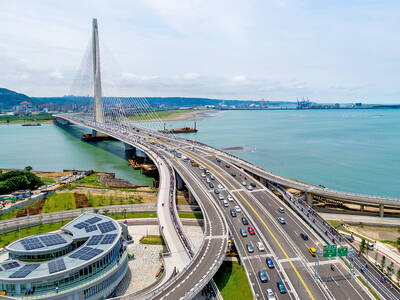
The Ministry of Transportation and Communications yesterday inaugurated the Danjiang Bridge across the Tamsui River in New Taipei City, saying that the structure would be an architectural icon and traffic artery for Taiwan. Feted as a major engineering achievement, the Danjiang Bridge is 920m long, 211m tall at the top of its pylon, and is the longest single-pylon asymmetric cable-stayed bridge in the world, the government’s Web site for the structure said. It was designed by late Iraqi-British architect Zaha Hadid. The structure, with a maximum deck of 70m, accommodates road and light rail traffic, and affords a 200m navigation channel for boats,
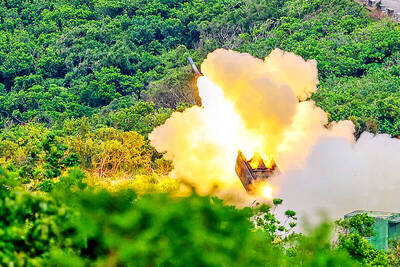
PRECISION STRIKES: The most significant reason to deploy HIMARS to outlying islands is to establish a ‘dead zone’ that the PLA would not dare enter, a source said A High Mobility Artillery Rocket System (HIMARS) would be deployed to Penghu County and Dongyin Island (東引) in Lienchiang County (Matsu) to force the Chinese military to retreat at least 100km from the coastline, a military source said yesterday. Taiwan has been procuring HIMARS and Army Tactical Missile Systems (ATACMS) from the US in batches. Once all batches have been delivered, Taiwan would possess 111 HIMARS units and 504 ATACMS, which have a range of 300km. Considering that “offense is the best defense,” the military plans to forward-deploy the systems to outlying islands such as Penghu and Dongyin so that
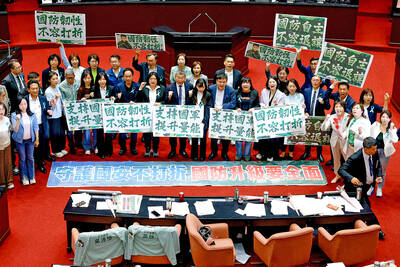
WHAT WAS ALL THAT FOR? Jaw Shaw-kong said that Cheng Li-wen had pushed for more drastic cuts and attacked him, just for the outcome to be nearly identical to his bill The legislature yesterday passed a supplementary budget bill to fund the purchase of separate packages of US military equipment, with the combined amount of spending capped at NT$780 billion (US$24.8 billion). The Chinese Nationalist Party (KMT) and Taiwan People’s Party (TPP) used their legislative majority to pass the bill, which runs until 2033 and has two main funding provisions. One was for NT$300 billion of arms sales already approved by the US for Taiwan on Dec. 17 last year, the other was for NT$480 billion for another arms package expected to be announced by Washington. The bill, which fell short of the NT$1.25

‘CLEAR MESSAGE’: The bill would set up an interagency ‘tiger team’ to review sanctions tools and other economic options to help deter any Chinese aggression toward Taiwan US Representative Young Kim has introduced a bill to deter Chinese aggression against Taiwan, calling for an interagency “tiger team” to preplan coordinated sanctions and economic measures in response to possible Chinese military or political action against Taiwan. “[Chinese President] Xi Jinping [習近平] has directed the People’s Liberation Army to be ready to invade Taiwan by 2027. China has a plan. America should have one too,” Kim said in a news release on Thursday last week. She introduced the “Deter PRC [People’s Republic of China] aggression against Taiwan act” to “ensure the US has a coordinated sanctions strategy ready should


 RSS
RSS